
Chippewa County Court Records After Arrest
After a Chippewa County jail arrest, the custody record and the court record separate. The jail record shows the booking side: lodging status, bond questions, arraignment questions, and any holds known to the jail. The court record starts when the criminal case is opened and charges are filed or reviewed through the 91st District Court, the prosecutor, and, for felony matters after bindover, the 50th Circuit Court. That court file is where formal counts, hearing dates, bond conditions, plea events, dismissals, amended charges, and sentences are verified.
For custody or booking status, use Chippewa County jail inmate records. For booking photos, use Chippewa County jail mugshots. Court records after a jail arrest answer a different question: what case was filed, which charge counts remain pending, and what the judge or clerk record shows after the arrest moves from the jail to the courtroom.
Find Chippewa County Court Records After Arrest
The broad online court search channel is MiCOURT Case Search. The portal can include criminal, traffic, civil, domestic, and probate records depending on court and case availability. Local court access also matters. The 91st District Court record-search page says anyone may use the public access computer during normal business hours for free. A clerk search carries a nominal fee, and the standard local search period is the past ten years. Searches older than 25 years require extra time because older records are not fully computerized.
- Search MiCOURT by party name, case number, ticket or citation, and court when available.
- Use the 91st District Court public computer or clerk search for local misdemeanor, felony-start, traffic, or preliminary-stage records.
- For felony cases after bindover, check the 50th Circuit Court and Clerk document process.
- Call the Circuit Court Clerk at 906-635-6300 before ordering copies, because the clerk requires a case number and exact amount due.
The 91st District Court clerk contact named in the research is Kim Forsythe at 906-635-7613. Circuit Court document copies are handled through the Clerk, with regular copies at $1 per page and certified copies at $10 for the first page plus $1 for each additional page.
Chippewa County Court Search Fields
MiCOURT is a case-search portal, not a jail roster. The field choices depend on portal mode and court availability, but the research found common search paths by court type, party name, case number, ticket or citation, and date of birth where available. Use exact spelling when possible. If a case number is already known from the jail, court notice, prosecutor, or clerk, it is usually more precise than name searching.
| Field Label | Type | Required | Notes |
|---|---|---|---|
| Court or Court Type | Dropdown | Required | Case availability varies by court and case type. |
| Search By | Tabs or dropdown | Required | Party name, case number, ticket, citation, or other supported mode. |
| Last Name or Business Name | Text | Conditional | Use for party-name searches. |
| First Name | Text | Optional | Narrows common names. |
| Date of Birth | Date or text | Optional where available | Useful for criminal cases with common names. |
| Case Number | Text | Conditional | Best when provided by the jail, court, prosecutor, or clerk. |
91st District and 50th Circuit Records
The 91st District Court handles the beginning of most criminal cases after arrest. Misdemeanor arraignment is the first court appearance, where rights and charges are explained, a plea may be entered, and bond is set. Felony cases also begin in District Court for arraignment and preliminary examination. At a preliminary examination, the question is probable cause, not guilt. If the judge finds enough evidence, the felony case is bound over to the 50th Circuit Court.
The 50th Circuit Court is at 319 Court Street and handles felony criminal matters after bindover. The Circuit Court page links to public case search and docket resources. The County Clerk maintains 50th Circuit Court criminal and civil files. For copies, call first for the case number and exact amount, then use the required request process. The official Clerk page says most Circuit Court criminal and civil files are public records, but availability still depends on case type, sealing, and exemptions.
Chippewa County Prosecutor Charges
The official prosecutor office is the Chippewa County Prosecuting Attorney, not a district attorney. Prosecutor Robert L. Stratton III reviews, authorizes, and prosecutes felony and misdemeanor violations committed inside Chippewa County. Jail booking charges may reflect arresting-agency allegations, while court charges reflect the prosecutor's charging decision and the court's case file. A charge can be filed, amended, reduced, dismissed, or bound over as the court record develops.
The captured source image below comes from the official prosecutor page and helps anchor the charge-review role to the local office.
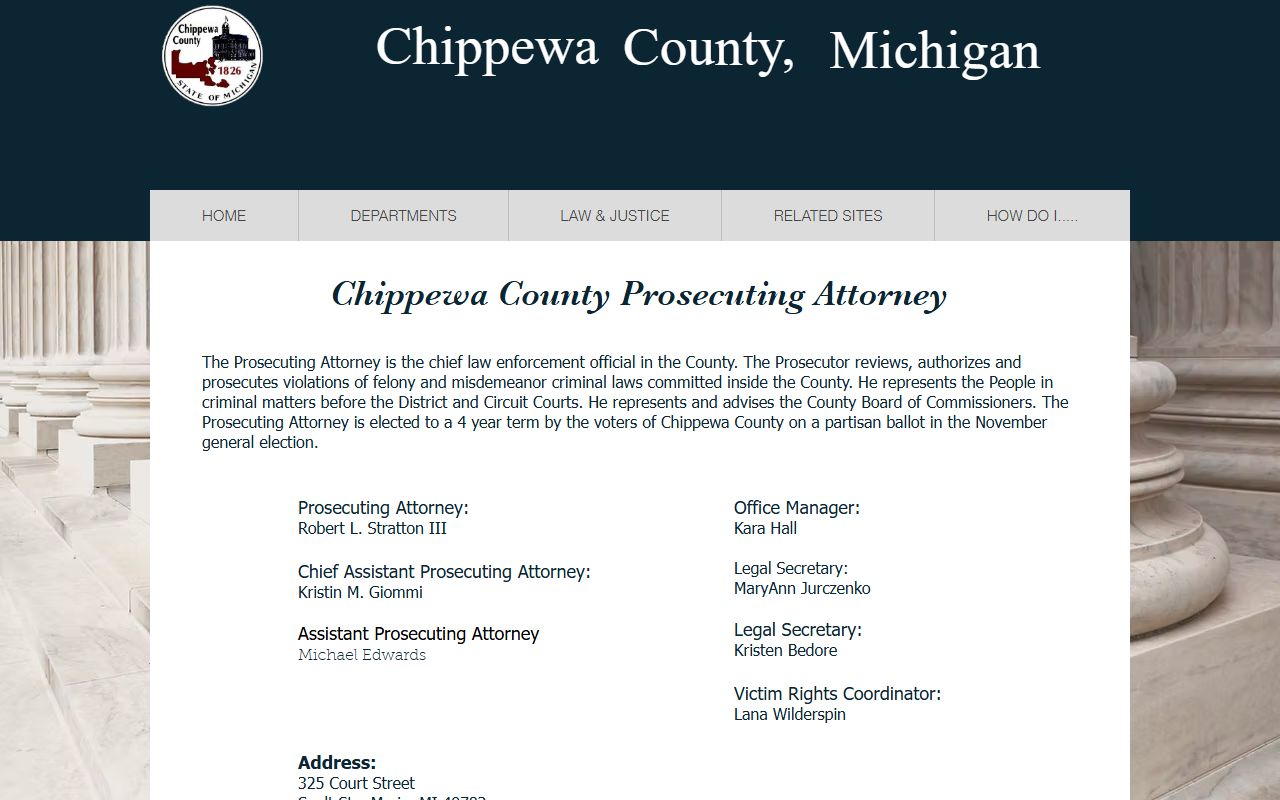
The prosecutor page is not a case search portal. Use it to identify the office role, then use MiCOURT, District Court, Circuit Court, or the Clerk for case records.
Charging Records After Jail Arrest
Michigan court records after a Chippewa County arrest can include different charging documents depending on the case stage. The research supports the complaint and information path most strongly through District Court and Circuit Court felony procedure. An indictment is less common in ordinary local court traffic but remains a recognized charging-document concept. The key point for a reader is that a booking entry is not the same as a prosecutor-filed court charge.
| Document | Common Role | What to Check |
|---|---|---|
| Complaint | Starts many criminal cases after arrest | Defendant, counts, probable-cause basis, and initial charge level |
| Information | Used after felony bindover to Circuit Court | Formal felony counts proceeding in Circuit Court |
| Indictment | Grand jury charging document | Filed counts if a grand jury path applies |
Chippewa County Charge Status
Charges can change after an arrest. A court record may show pending counts, amended counts, reduced charges, dismissed charges, plea entries, bindover, sentencing, probation, fines, costs, or jail time. A felony case can begin in District Court and later move to Circuit Court, so a complete review may require both court levels. A misdemeanor may remain in District Court through plea, trial, sentence, or dismissal.
| Status | Meaning in Court Records |
|---|---|
| Pending | The charge remains open and has not reached final disposition. |
| Amended or reduced | The prosecutor or court changed the count, level, or charge description. |
| Dismissed | The count was dropped by court order, plea agreement, lack of proof, or other legal reason. |
| Bound over | A felony moved from District Court to Circuit Court after probable-cause review. |
| Sentenced | The court entered punishment or terms after plea or conviction. |
Bond Records After Arrest
Bond starts at the jail and court edge. The jail page says the booking officer can answer bail and arraignment questions, and that bonds posted at the jail must be cash or through a bail bondsman. Checks and foreign currency are not accepted. The 91st District Court bond page says a District Court Judge or Magistrate sets bond on all criminal cases, and some minor offenses have standard bonds that allow quick release. Bond conditions can include no contact, no alcohol, no bars or taverns, curfew, or other terms.
| Bond Type | How It Works Locally |
|---|---|
| Cash bond | Accepted by the jail. Confirm amount and conditions first. |
| Bail bondsman | The jail page says bonds can be posted through a bondsman. |
| Standard bond | Some minor offenses have judge-set standard bonds. |
| Conditional bond | May include no-contact, no-alcohol, curfew, or similar court terms. |
| Hold or detainer | ICE, parole, probation, another county, federal custody, or a court order may block release. |
Warrants and Jail Arrest Records
No official public Chippewa County Sheriff's active-warrant search page was located. If a warrant led to arrest, check the jail for current booking status and the court case for bench warrant, failure-to-appear, bond forfeiture, probation, or show-cause entries. For non-emergency routing, the Sheriff's Office phone is 906-635-6355 and Central Dispatch non-emergency complaints are 906-495-3312. Do not use 911 for a records question.
A bench warrant is a court order issued for failure to appear or violation of a court order. An arrest warrant is based on complaint or probable cause. A search warrant is not a custody record. Tether and work-release rules also show why warrant status matters locally: a person may not qualify if active arrest warrants exist.
Charges vs Convictions
A charge after a Chippewa County arrest is an accusation filed or pursued in court. A conviction is a final outcome after a plea or finding of guilt. This distinction matters for background checks, employment questions, housing questions, and court-record interpretation. A pending charge can later be dismissed or amended, and a booking charge can differ from the formal court count.
| Charge | Conviction | |
|---|---|---|
| Stage | Accusation or filed count | Final plea or finding of guilt |
| Proof Level | Probable cause or charging decision | Beyond a reasonable doubt or admitted by plea |
| Can Change | May be amended, reduced, or dismissed | May be appealed, set aside, or otherwise changed only through legal process |
Sealed and Expunged Arrest Records
Michigan law provides separate paths for certain arrest-record removal and conviction set-aside. MCL 764.26a addresses removal of certain arrest records from ICHAT when charges are dismissed before trial and conditions are met. MCL 780.621 is the Michigan set-aside statute for eligible convictions. These laws do not mean that every jail, court, or third-party copy vanishes automatically.
| Sealed or Restricted | Set Aside or Expunged | |
|---|---|---|
| Public View | Hidden or restricted from public access in certain systems | Eligible conviction is set aside under statute |
| Applies To | Case files, juvenile matters, or restricted records depending on order and law | Eligible convictions or arrest records under Michigan law |
| Still Verify | Court clerk and originating agency should confirm status | Confirm with court, MSP/ICHAT, and originating agency where needed |
Restricted Chippewa County Court Records
Public access has limits. Juvenile matters, sealed cases, victim-sensitive records, active investigative material, exempt FOIA information, and records restricted by court order may not be available in the same way as ordinary public criminal case records. Michigan FOIA also has exemptions, and a court clerk cannot provide legal advice about what a record means. For exact case status, use the originating court, the Clerk, MiCOURT, or formal records request channels.
Important: Court records should not be used for FCRA-covered screening unless obtained through a compliant consumer-reporting process.